

Monicah Wairimu

Monicah WairimuMonicah, an orphan, is the third and final PATHWAYS scholar for 2005. An outstanding student, she earned a B plain on the national school leaving exam. Monicah began her studies in Mathematics and Computer Science at Kenya Methodist University in September, 2005 and graduated in July 2009. Her project  focuses on addressing the fresh water supply problems in Elementaita.  The water is contaminated with fluoride so community residents have to walk many kilometers to obtain potable water. Monicah reflected in 2005, “Most of us have a vision of improving people’s lives in the society, but it is not possible due to financial problems.”

2007 Update

Monicah has continued to excel in her university work at Kenya Methodist University. Monicah says “Forming discussion groups with my classmates has assisted me to perform well mostly in the subjects that are a bit hard. Teamwork has proved to be a great idea. Interacting with so many students from different backgrounds has made me learn to cope with people. It has made me appreciate different personalities that people have. We are different hence perceive things differently.

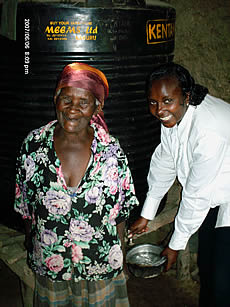
Water tankIn addition to her university responsibilities Monicah also works on her PATHWAYS community project – safe water for her village Elementaita. The borehole water in Elementaita is contaminated with fluoride and salt and thus can only be use for washing. She successfully applied for PATHWAYS project funds and received the maximum award of $500 in 2006.

She started her project by purchasing 1000 liter water tanks for four needy families in her village (Monicah is pictured below drawing water from the water tank with the head of one of the families). “Working in my project in my home area has helped me interact with community members at a personal level. This has helped me give the most needy families the first priority in benefiting with the water tanks. Community members have very high expectations on my project this motivates me even to work harder. Project evaluation is essential to keep one focused and to know whether you are making progress or not. I will be evaluating my project in April and looking forward to positive results.“

Monicah with water tank recipient2008 Update

Monicah is working to make her water tank project self sustaining so she has developed another project that will help to fund the water tanks for needy families in her community of Elementaita long term. She says, “In Elementaita there is only one primary school that is densely populated with not enough facilities. My proposal of starting a nursery school will ease congestion in that primary school and because the pupil’s population will be few the teacher will have time to concentrate on each child. This in return will lead to better understanding and good results. Each child will be charged Ksh 200 per month. This is very little compared what is charged in other schools. Any surplus money from the project will be going back to the water project.”

Most of the activities will start this year because the school is supposed to start in January. Monicah says, “With the help of committee members and parents who are willing to help in the management of the school, the project will be a great success.”

2009 Update


Monicah is our first graduate and has set an exemplary example of participating in the running of the PATHWAYS program during the last year.  Because of this and the excellent progress she has made on her project, she was awarded the “2008 Role Model of the Year Award”.

pupils-in-class-writing4To help make her water tank project sustainable, Monicah launched her nursery school project in January 2009.  The school is named St. Lucy Elementaita Nursery School in honor of her late mother, Lucy Wairimu who was very active in community issues, especially with regard to empowering women and educating children. There was a great need for the nursery school in the area as evidenced by the large initial enrollment of 74 children.  The tuition charged each month is about $2, yet even this modest fee is too much for some families or single parents or grandparents.  In these cases, the children are given a waiver of fees.

Nursery school schildren and their caregivers. Many are part of the women's group.To address the issue of inadequate income among parents of the nursery school students, a women’s group was formed.  They were asked to come up with an idea for income generation and based on their knowledge of the local area and economy they decided on poultry raising. They intend to start with 300 chicks (broilers) and will sell them to local hotels when they are mature.  This poultry rearing project will help the parents of the nursery school students pay the monthly nursery school tuition fee as well as help them improve their own family finances.  All surplus funds from the nursery school project will return to the water project.  It is expected that three families will receive a water tank in the next year. Monicah’s goal is for the income from the nursery school to increase annually so that in five years, 50 tanks will be bought and distributed to needy families.

2010 Update

pathway_sch2
▪Registered women’s group.
▪Made 10 desks for nursery school
▪Started a Class 1 in nursery school.
▪Started sanitary towel project with young girls to help girls be able to not miss school during their periods and for income generation.  See one of the girls displaying a sample below.

Plans for 2010/2011
▪Make 15 more desks
Maureen Awino displays her sample▪Purchase land for school
▪Start pilot rabbit rearing project with women’s group
▪Purchase land to build a nursery school (currently nursery school is located in church)
▪Use proceeds from nursery school to purchase water tanks

2011 Update

project_visit_dec 010Monicah has continued volunteering for PATHWAYS as an Outreach Coordinator and in addition to her job, continues to work with her community on her PATHWAYS project. This year Monicah has:
▪Helped her community women’s group start a rabbit rearing business
▪Purchased land for a new school
▪Worked to recruit more adolescent girls to a girls group to make reusable sanitary towels

Comments are closed.